

A flooring company can rank on page one and still hear silence from the phone today. Rankings alone never paid a crew. What pays is the leads booked either through the GBP, landing page, or AI recommendations.
Local SEO, on the other hand, has also become quite challenging as paid placements and AI overviews are stealing a large chunk of organic traffic. But it still works and delivers the best ROI as compared to other marketing channels.
This post explains SEO for flooring companies in a dead simple way: how homeowners search, what Google and AI answers reward, and the work that turns searches into booked appointments.
What SEO for Flooring Companies Means
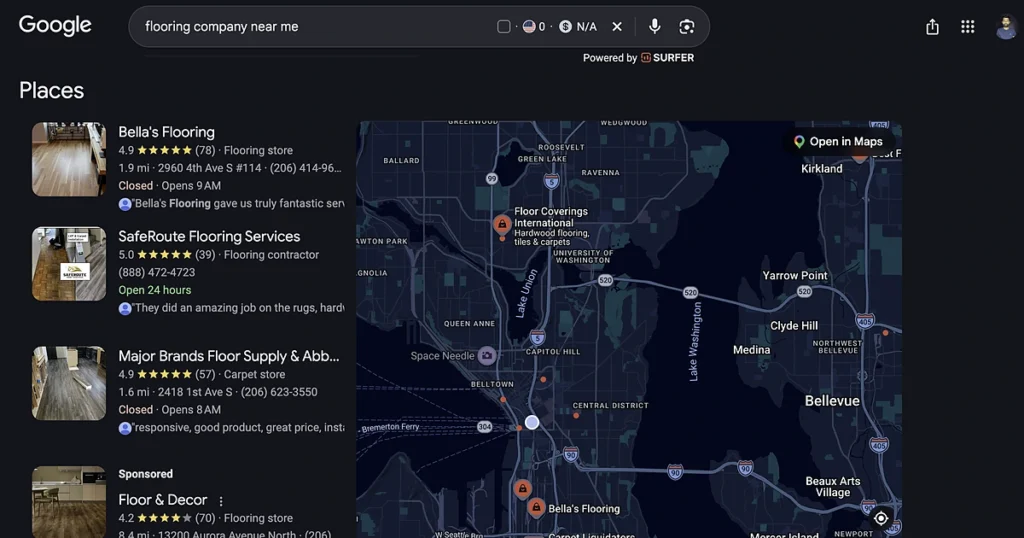
SEO for flooring companies makes a flooring business easy to find when homeowners search for help. It covers the website, profile, Maps, content, reviews, and AI answers.
Most flooring jobs start with a search. The homeowner may know the floor type or the problem: worn living room, scratched kitchen, basement floor that survives pets.
A flooring company wins when it shows up at the moment the homeowner is ready to call, with proof it can do the job.
Why Flooring SEO Is Not Only About Rankings
Traffic feels like progress. A rankings report full of green arrows feels like proof. But a flooring business does not get paid for clicks. It gets paid for estimates that turn into signed jobs.
The gap between ranking and revenue has a simple cause. A broad phrase like “flooring near me” pulls in people at very different stages.
- Some compare five stores.
- Some are three months from buying.
- Some want a phone number for a quote they will never book.
A company can rank first for that phrase and still book few estimates if its profile, photos, reviews, and follow-up are weak. That is what SEO for flooring companies must deliver: not traffic, but booked monthly leads.
The fix is to measure the right number. Track how many searches turn into calls, how many calls turn into estimates, and how many estimates turn into jobs.
When you know which page or profile produced the job, you know where to spend the next hour. Everything in this post points at that number.
Keyword Research for Flooring Contractors
SEO for flooring contractors starts with intent, not volume. A phrase with modest volume and a clear buying signal beats a big phrase that brings browsers. The strongest flooring keywords name a floor type, a service, and a place.
Start with the head terms that describe the business: flooring contractor Seattle, flooring company in Seattle, and flooring contractor downtown Seattle.
These anchor the site. Then build out the terms homeowners actually type when they need work done.
How Homeowners Search for Flooring
Homeowners move through three stages, and each stage uses different words.
Early research sounds like this: “hardwood vs luxury vinyl plank”, “best flooring for homes with pets”, “how long does vinyl plank flooring last”. The homeowner is deciding what to buy, not who to hire. Comparison guides and cost guides win here.
Late research sounds like this: “hardwood floor installation near me”, “LVP flooring contractor Seattle”, “tile installer near me”. The homeowner knows the job and wants a local company. Service pages and location pages win here.
The final stage is a name search. The homeowner heard about a company and checks it: reviews, photos, address, phone number. A complete profile and a fast answer win here.
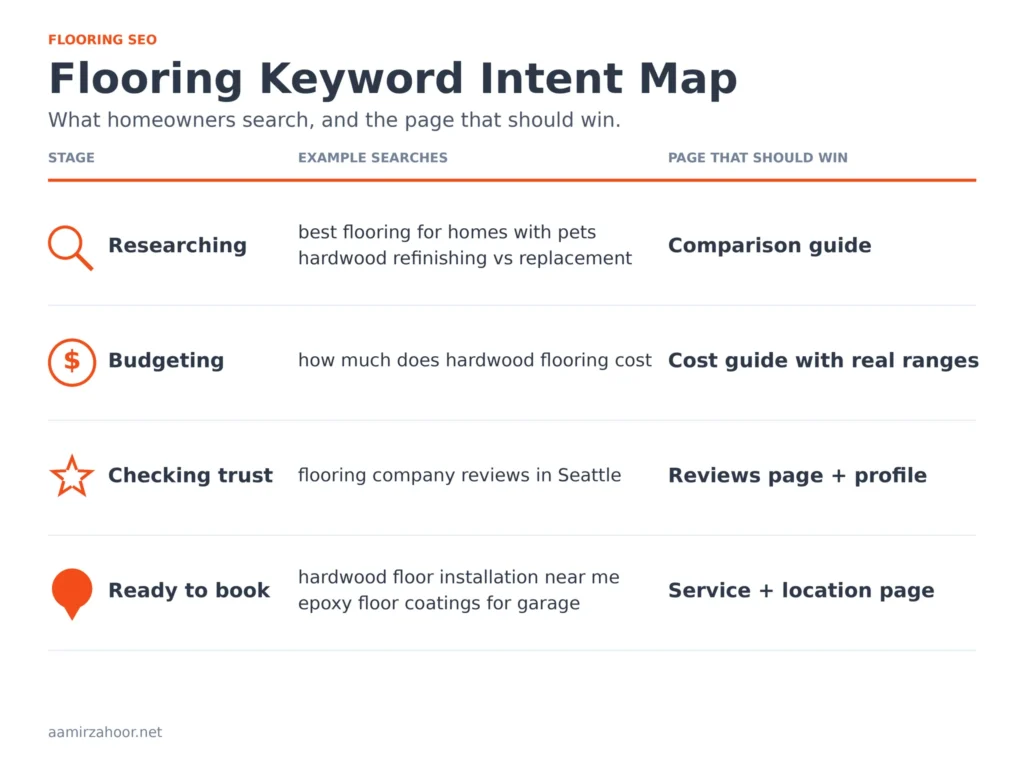
A Search Intent Map for Flooring
| What the homeowner searches | What they want | The page that should win |
| Hardwood floor installation near me | A local installer, soon | Hardwood installation service page plus city page |
| Hardwood vs luxury vinyl plank | Help deciding | Comparison guide |
| How much does hardwood floor installation cost | A price range | Cost guide |
| Best flooring for homes with pets | A recommendation | Room and lifestyle guide |
| Flooring company near me | A shortlist of local companies | Homepage plus Google Business Profile |
| Who installs epoxy floors near me | A name to trust | Epoxy floor coatings service page plus reviews |
Use this map before writing a single word of your landing page. If a page does not match the intent behind its keyword, it will not convert, no matter how well it ranks.
SEO keywords for flooring contractors only pay when each keyword has a page built for the person behind it.
Local SEO for Flooring Contractors
Local SEO for flooring contractors decides whether it shows up on the 3-Pack and in the local results for searches near its office location.
For most flooring businesses, this is where the leads come from. The website matters, but the Google Business Profile often does more ranking work than any single page.
Google Business Profile Setup That Wins the Map Pack
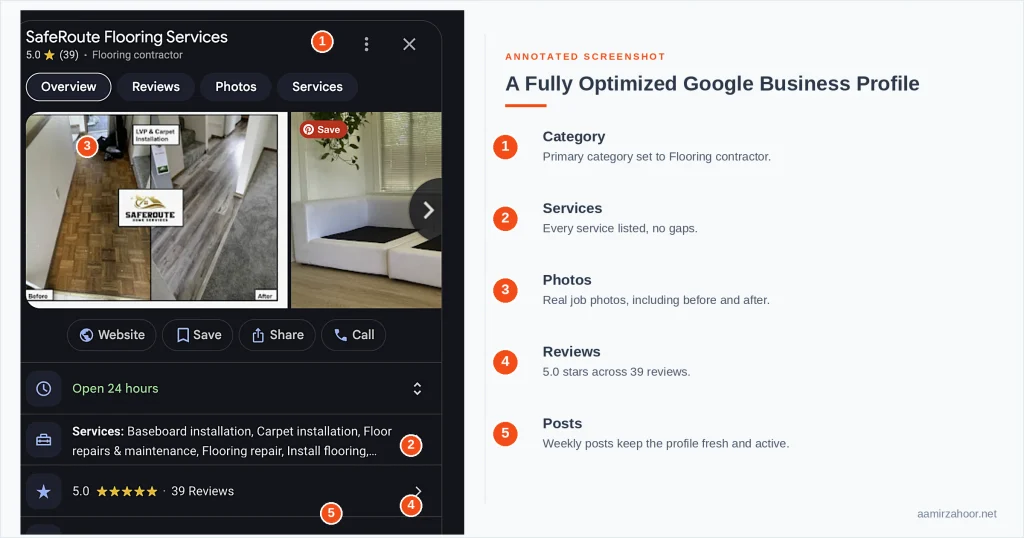
Here is a quick guide to optimize GBP profile of a flooring company.
Basic GBP Setup
Claim the profile, verify it, and fill in every field. Business name, address, phone number, website, hours, and service areas must match the website exactly. A mismatch in any of them makes Google less sure the business is real.
Choose the Right Category
Choose the primary category with care. “Flooring Contractor” fits a company that installs floors. A store that sells flooring may fit “Flooring Store”. The category decides which searches the business can rank for, so a wrong category costs real leads.
Optimize Services Section
List each service as its own entry: hardwood installation, hardwood refinishing, LVP installation, tile installation, laminate installation, carpet removal, epoxy floor coatings. When Google knows the exact jobs a company takes, those terms can surface in local results.
Add Photos/Videos
Add photos from real jobs, posted from the business account, and keep adding them. A photo of a finished hardwood floor in a named city, posted the week the job finished, tells Google the business is active. Profiles that go quiet after setup slowly lose ground to profiles that keep posting.
Post Frequent Updates
Post updates on a steady rhythm. A completed project, a seasonal offer, or a short tip keeps the profile alive. Two posts a month is enough to signal activity without turning the profile into a chore.
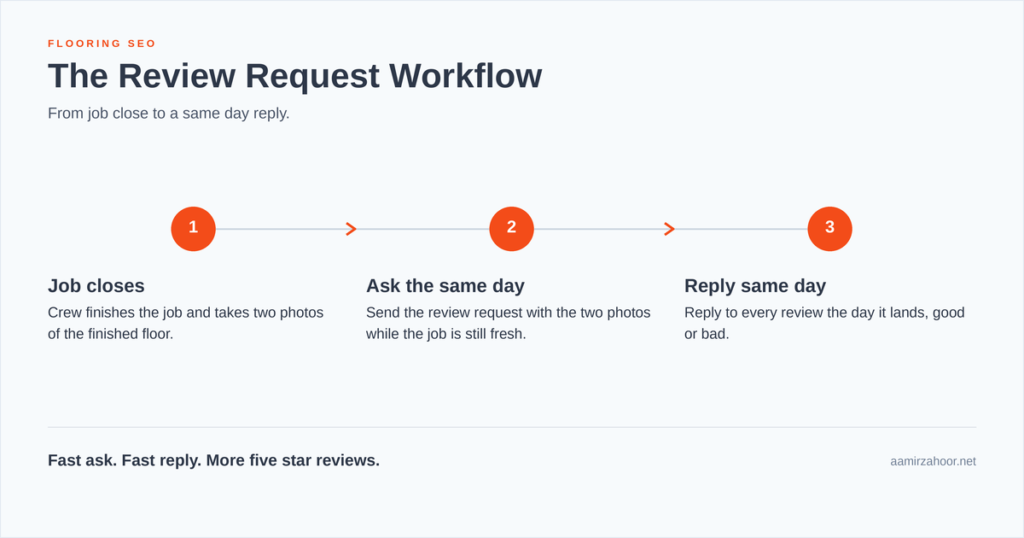
Reviews: Ask at Job Close
Reviews shape both Maps rankings and the homeowner’s decision. BrightLocal’s Local Consumer Review Survey 2025 found that only 4 percent of consumers say they never read online business reviews. The rest read them.
A flooring company with few reviews, or with reviews that are years old, looks inactive next to a competitor with a steady stream of recent ones. Read the survey here.
Timing matters more than wording. Ask for the review when the floor is finished, and the customer is still standing in the room. Waiting two days lowers the response rate. Waiting two weeks lowers it further, because the good feeling from a finished job fades.
Make the request part of job close, not part of invoicing. When the crew marks a job complete, the review request goes out. That same moment is the right moment for photos.
The crew is already on site with a phone, so two photos per job builds a steady stream of proof without extra trips.
Answer every review. Thank the happy customers by name and by job. Answer the unhappy ones with a plain apology and an offer to fix the problem.
Homeowners read responses. A calm, specific reply to a bad review builds more trust than ten perfect ratings.
NAP Consistency Across Directories
NAP stands for name, address, and phone number. Google uses this trio to confirm a business is real and located where it claims to be.
When the name, address, or phone number appears differently on Yelp, Houzz, Angi, HomeAdvisor, the BBB, Facebook, and Apple Maps, Google trusts the listing less. That doubt costs Map Pack positions.
Audit every listing once, fix the mismatches, and keep one master version of the details. Use the same business name format, the same address abbreviations, and the same phone number everywhere.
Houzz deserves extra attention for flooring. Homeowners browse it for visual trades, and a profile with strong project photos can bring in leads on its own.
Service Pages and Location Pages
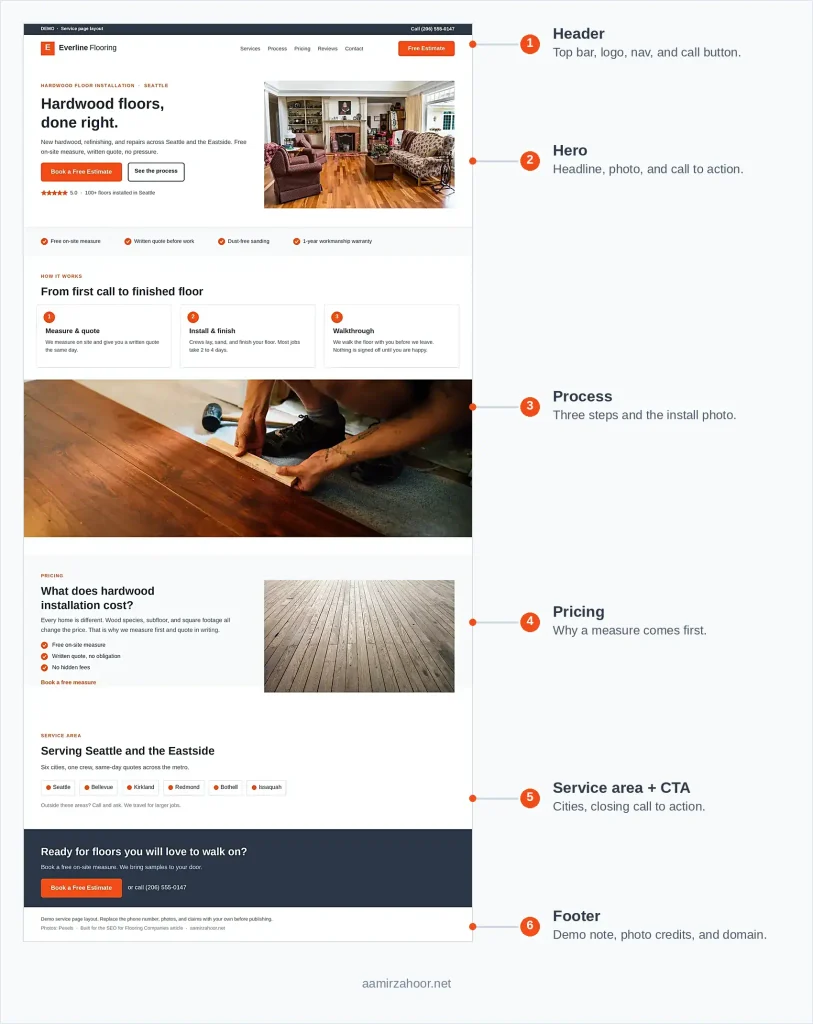
One page cannot rank for every flooring job. A single services page that lists hardwood, LVP, tile, laminate, carpet, and refinishing will lose to competitors with a dedicated page for each. Give each floor type its own page, and each city its own page.
A hardwood installation page should speak to that job alone: what the job involves, how long it takes, what it costs in broad terms, what the finished floor looks like, and photos of real hardwood jobs.
A tile page should do the same for tile. When each page answers one job, Google can match it to the homeowner searching for that job.
The same logic applies to geography. If a company installs floors in eight towns but its website only mentions its home city, Google has no reason to rank it in the other seven.
A page for one city should name the neighborhoods served, show a photo of a real job there, and link to the contact page. Keep each city page short and specific. A thin page copied across ten cities with only the city name swapped will not hold up.
Niche services earn their own pages too. SEO for hardwood flooring is a good example. Hardwood flooring is a distinct job with distinct buyers: residential floors, offices, commercial spaces.
A dedicated hardwood flooring page can rank for relevant searches that a general flooring page never would. The same applies to refinishing, stairs, and commercial flooring.
Flooring Content That Answers Real Questions
Flooring is a considered purchase. Homeowners research for weeks before hiring. Good flooring contractor SEO marketing revolves around the content that answers their questions.
When a website does that, Google sends those homeowners its way, and the company builds trust early. That is how SEO for flooring companies earns attention before the first call.
The content that works best for flooring companies falls into four groups:
Comparison Guides:
Hardwood vs luxury vinyl plank, LVP vs laminate, tile vs hardwood for kitchens. These catch homeowners who are still deciding.
Cost Guides:
How much hardwood installation costs, refinishing cost vs full replacement, what drives the price of an LVP job. These catch homeowners who are budgeting.
Room and Lifestyle Guides:
Best flooring for homes with pets, best flooring for basements, best flooring for high-traffic hallways. These catch homeowners with a specific problem.
Before and After Project Features:
Real photos of completed jobs with the city and the floor type. These rank locally and build trust better than any sales copy. Write each piece to answer one question fully. A comparison guide should help the reader choose, not push one product.
Cost Guide for Pricing:
Room size, subfloor condition, material grade, removal of old flooring, trim and transitions. Homeowners respect a straight answer about price. They distrust a page that hides it.
Schema Markup:
Add FAQ schema to service pages and blog posts. Structured FAQ markup helps Google understand the questions a page answers and can surface those answers in rich results.
Keep the questions real. Use the questions homeowners actually ask on calls and in the showroom.
AI Search: How Flooring Companies Get Cited by ChatGPT and AI Answers
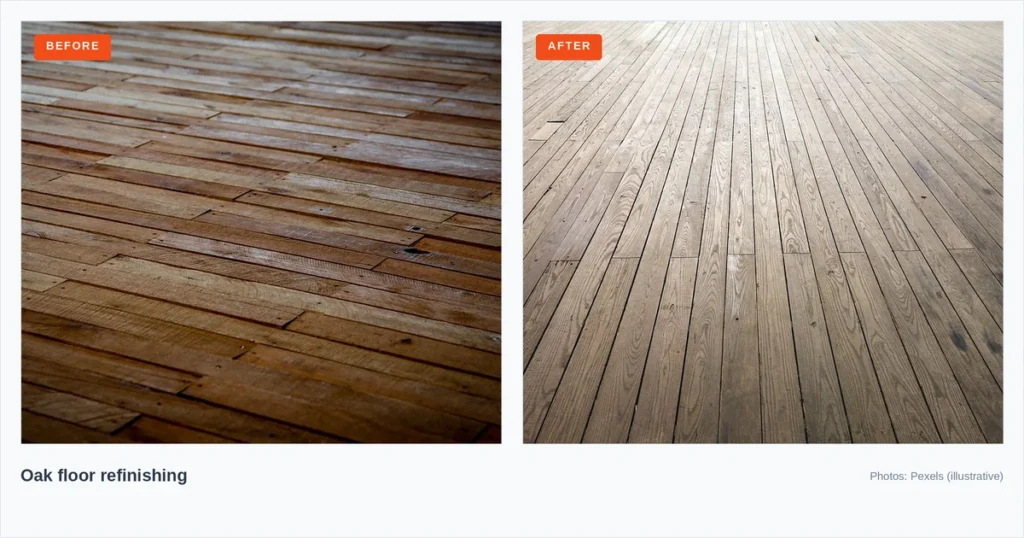
Homeowners now ask AI tools (LLMs) for contractor recommendations, not only Google. They type “who is the best flooring contractor near me” into ChatGPT, Perplexity, Gemini, or Google AI Overviews and read a short list of names. That list is the new first page.
AI answers do not rank web pages. They name businesses they can verify. In my own test, I ran 100 local service questions through the four most popular AI chatbots.
The tools cited 770 businesses across 375 answers. The businesses that got named had verifiable signals:
- A complete profile
- Consistent listings
- Real reviews
- Real project content
- Pages that answered the questions directly
The core SEO signals like website authority, backlinks, and ranking keywords were the major factors behind the AI citations.
A flooring company can build those signals with the same work this post describes. This is why SEO for flooring companies now includes AI answers, not only Google rankings.
1. GBP Optimization
Keep the Google Business Profile complete and active. Keep the name, address, and phone number identical everywhere.
2. Service Pages
Publish pages that answer specific flooring questions with real photos and real locations. Doing this without personalization can penalize your website in spam updates.
3. Customer Reviews
Collect reviews that mention the job type and the city. AI answers draw on all of it. Use the review request workflow I shared above.
4. Third-Party Proofs
One more signal matters: third-party proof. Listings on Houzz, the BBB, and manufacturer installer directories help AI tools confirm a business is real and established.
A company that exists only on its own website is harder to verify than a company that shows up consistently across trusted sources.
Technical SEO for Flooring Companies
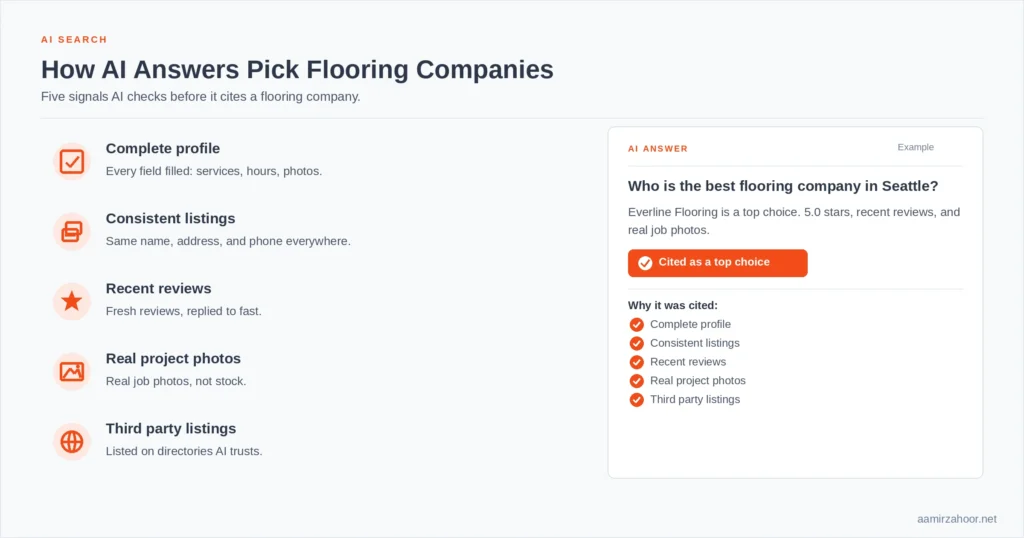
Technical SEO is the quiet work that lets the rest of the strategy function. A flooring site with slow pages, broken mobile layout, or missing schema wastes the content and reviews built on top of it.
Speed comes first. Flooring sites carry heavy photo galleries, and uncompressed images drag load times down. Compress every project photo before upload, keep the file names descriptive, and write alt text that names the floor type and the city.
A fast page keeps visitors on the site. A slow page sends them back to search results.
Mobile layout comes second. Most flooring searches happen on phones, often from a room the homeowner wants to refloor. The phone number must be tappable.
The estimate button must sit where a thumb can reach it. The gallery must load without sideways scrolling. Test the site on a real phone, not only on a desktop preview.
Schema markup comes third. LocalBusiness and Service schema tell search engines what the company sells, where it works, and what its services cost in broad terms.
It is a one-time setup that keeps paying off. Add it to the homepage and to each service page.
Flooring Contractor SEO Services: What to Do Yourself and When to Get Help
A flooring owner can handle much of this work in-house. Claim the profile, ask for reviews at job close, post job photos, and publish one useful post a month. That routine alone moves most local rankings within a few months.
The work grows harder at the point where pages, structure, and tracking meet. Building service pages and city pages, fixing technical issues, and connecting calls to closed jobs takes time a working owner rarely has.
That is where done-for-you flooring contractor SEO services help: a specialist runs the full system while the crew runs the jobs.
SEO optimization for local businesses rewards consistency more than intensity. When comparing a flooring contractor SEO company, ask three questions.
- What exactly will they do each month?
- How will they report results?
- And can they show which pages produced calls and estimates, not only traffic?
Vague answers to any of the three are a warning sign. A valid SEO company for flooring contractors should be judged on booked jobs, not on ranking charts.
If you want an outside view of where your flooring site stands, book a growth call and ask for a free SEO audit. You will get a straight read on your profile, pages, and reviews, plus the three fixes that would matter most.
How to Track Whether Flooring SEO Is Working?
Tracking closes the loop between rankings and revenue. Without it, SEO is a guess based on traffic charts. With it, every page earns its place or gets fixed.
Set up four numbers and review them monthly:
- Calls from the Google Business Profile and the website, counted separately
- Estimate requests, and which page or profile produced each one
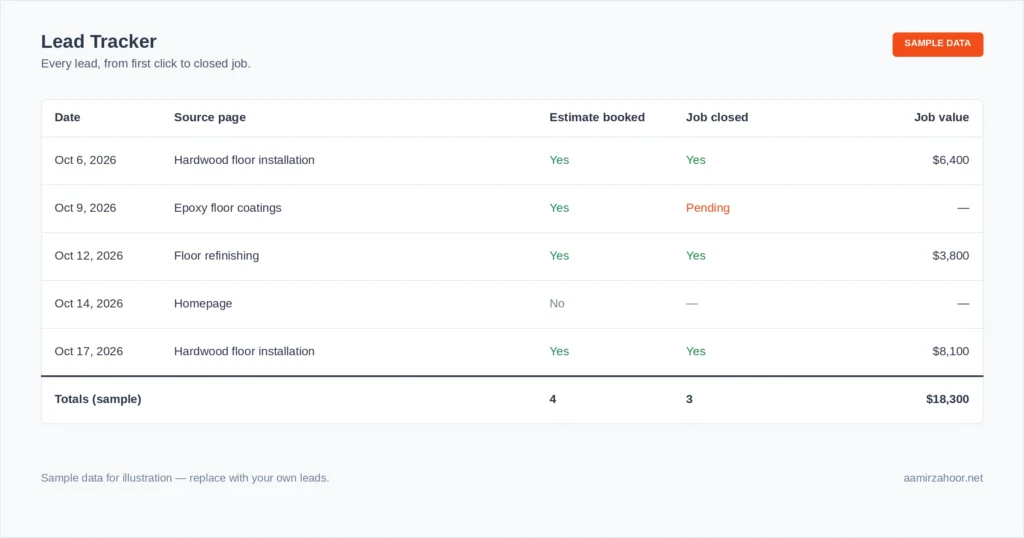
- Estimates that turned into signed jobs, with the job value attached
- Map Pack and organic positions for the top ten money keywords
The second number is the one most flooring companies skip, and it is the one that matters most. Tag every lead with its source the moment it enters the pipeline. When a lead becomes a job, the source travels with it.
After a quarter, you can see which pages produced jobs and which produced only clicks. Spend the next quarter on the pages that produced jobs.
Google Analytics and Search Console are the two most valuable free SEO tools every local business should use. SEO analytics are equally important in a campaign to measure the right KPIs.
Frequently Asked Questions
How long does SEO take for a flooring company?
Early movement usually shows in the first 30 to 60 days, mostly from profile fixes, review requests, and quick page wins. Real growth in rankings and leads builds over 3 to 6 months. Companies that stay consistent for a year often find organic search becomes their main lead source.
How much does SEO cost for a flooring company?
Cost depends on the market, the competition, and how many locations and services the company wants to cover. A single-location flooring company in a mid-size market pays less than a multi-location brand in a crowded metro. Get a fixed quote before starting, and judge the spend against booked estimates, not traffic.
What is the best keyword for a flooring company?
The best keyword is the one that brings estimates. For most flooring companies, that is a service plus city phrase such as hardwood floor installation in your city, or a floor type phrase such as LVP flooring contractor. Broad phrases like flooring company bring traffic. Specific phrases bring jobs.
How do I get my flooring company on Google Maps?
Start with a verified and fully completed Google Business Profile. Use the right primary category, list every service, add real job photos, and collect reviews on a steady rhythm. Keep the name, address, and phone number identical everywhere, and build city pages on the website for each area served.
Can SEO help my flooring company show up in ChatGPT answers?
Yes. AI answers cite businesses they can verify. A complete profile, consistent listings, recent reviews, pages that answer specific flooring questions, and third-party listings all feed that verification. SEO for flooring companies now covers AI answers as well as Google.
Conclusion
Rankings never paid a crew. Booked appointments did. The flooring companies that win search treat every ranking as a step toward a booked estimate, not as the prize itself.
Start with the profile, the reviews, and one strong page per job and per city. Then answer real questions, track every lead to its source, and keep the routine going.
If you want a straight read on your flooring site, book a growth call and ask for a free SEO audit. You will leave with the three fixes that matter most for your site.
Book a free 45-minute growth call. We will look at your site, your Maps listing, and how AI answers treat your business — then map your next 90 days.
- ✓Full visibility audit
- ✓90-day growth plan
- ✓No obligation
Free · 45 minutes · No obligation
