

I ran the 100 home-services questions through ChatGPT, Perplexity, Gemini, and Google AI Overviews. The results changed what I thought I knew about local SEO.
My SEO journey started back in 2020 and continued through all the industry ups and downs. I hear a lot of buzz about AI search takeover. So I decided to dig into the reality behind these claims.
Every local business owner I talk to asks a version of the same question: when someone asks an AI chatbot for a roofer or a plumber, does my business show up?
I was tired of answering from opinions, mine or anyone else’s. So I ran a test.
| Key numbers | Details |
| 400 | Observations – 100 prompts × 4 platforms |
| 375 | Answers – 25 clarification-only, guide-only, or no-trigger |
| 1,606 | Business mentions – 770 distinct businesses |
| 22 | Most AI citations earned by one business |
What I actually did:
I wrote 100 questions a Seattle-area homeowner would genuinely ask. Five trades covering HVAC, plumbing, roofing, remodeling, and electrical. Five markets: Seattle, Bellevue, Tacoma, Everett, and Redmond.
Four kinds of intent: “what are the best…”, “find reputable companies near me…”, “I need help with an emergency…”, and “recommend and compare…”.
Then I ran every question once on each of four platforms: ChatGPT Search, Perplexity Search, Gemini, and Google AI Overviews. I ran the test on October 16, 2026. One fresh conversation per question. No rewording, no follow-ups, no hints about what to cite.
When a platform asked a clarifying question instead of answering, I left it that way; that counts as what happened, not as an error to fix.
400 observations. 375 answers. 1,606 business mentions.
The first surprise: Google went silent in exactly one city
Google AI Overviews answered 83 of its 100 prompts. The other 17 times, it simply didn’t trigger an AI answer at all. All 17 were Redmond.
Google answered 20 out of 20 in Seattle, Bellevue, Tacoma, and Everett. In Redmond, it answered 3 out of 20. Same questions, same format, same day. The only thing that changed was the city in the query.
If you’re a Redmond contractor watching your AI visibility, know this: on the day I tested, Google’s AI answer didn’t show up for your market at all.
The other platforms answered Redmond fine: Perplexity 99 out of 100 overall, Gemini 98, ChatGPT 95.
That was the first sign that “AI search” isn’t one thing. It’s four different systems that behave differently.
The same names kept coming up, and hundreds appeared once
Across all 375 answers, the platforms named 770 different businesses. But 472 of them appeared exactly once. One mention, then gone.
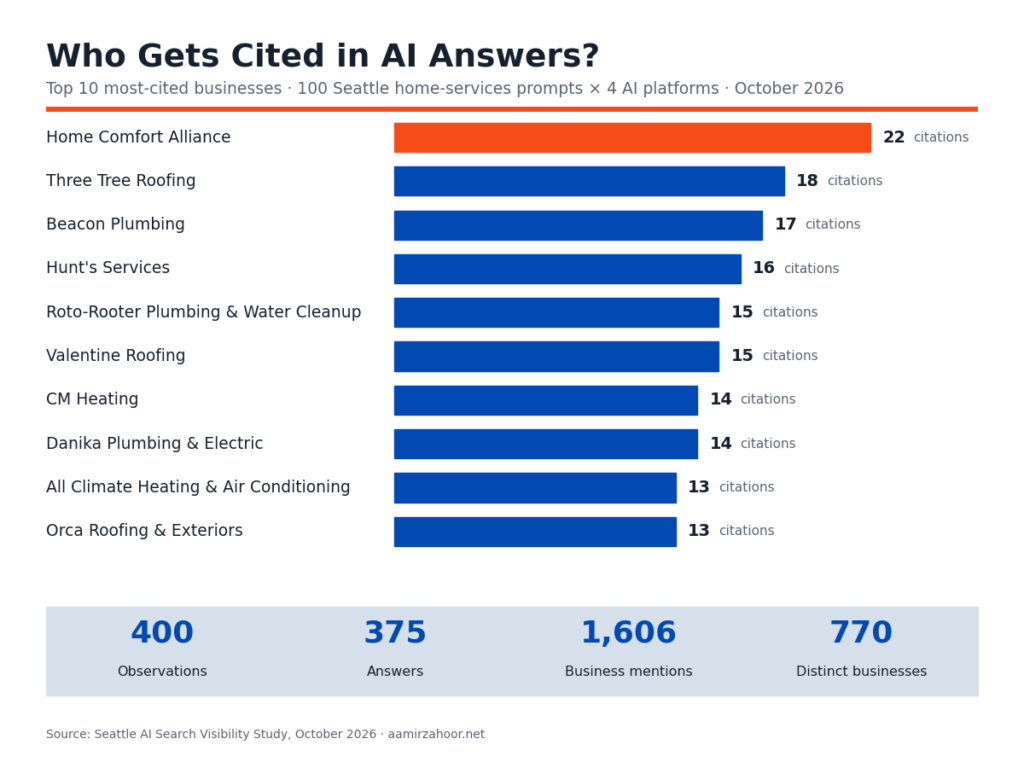
At the other end, a small group dominated. The 50 most-cited businesses took nearly 30% of all mentions. The single most-cited business, Home Comfort Alliance, showed up 22 times.
Here’s the top of the list:
| Business Name | Times Cited |
| Home Comfort Alliance | 22 |
| Three Tree Roofing | 18 |
| Beacon Plumbing | 17 |
| Hunt’s Services | 16 |
| Roto-Rooter Plumbing & Water Cleanup | 15 |
| Valentine Roofing | 15 |
| CM Heating | 14 |
| Danika Plumbing & Electric | 14 |
What struck me wasn’t just the concentration. It was how local the winners were. CM Heating and Danika Plumbing & Electric were each cited 14 times every single time in Everett queries.
Three Tree Roofing’s 18 citations were 11 in Bellevue, 6 in Seattle, 1 in Redmond, and nothing in Tacoma or Everett. The businesses winning in each market were businesses of that market. A thin presence everywhere lost to a deep presence somewhere.
The platforms don’t agree with each other
This one genuinely surprised me. Only 25 businesses were cited by all four platforms. 569 were cited by exactly one.
Roto-Rooter Plumbing & Water Cleanup was the 5th most-cited business in the whole study. Perplexity never named it once.
Valentine Roofing, tied for 5th, was never named by ChatGPT, but Gemini named it 9 times. Hunt’s Services got 7 Google citations and 5 from Perplexity, and exactly 1 from ChatGPT.
So “am I visible in AI search?” is the wrong question. The right question is “visible where?” A business can lead on one platform and be invisible on another, and the homeowner asking the question will never know the difference.
The answers even look different. Perplexity averaged 10.6 source links per answer. Gemini averaged 1.7; most Gemini answers cited a single source or barely any. Same question, same day, wildly different evidence on display.
So do Google ratings drive AI citations? Not the way I expected
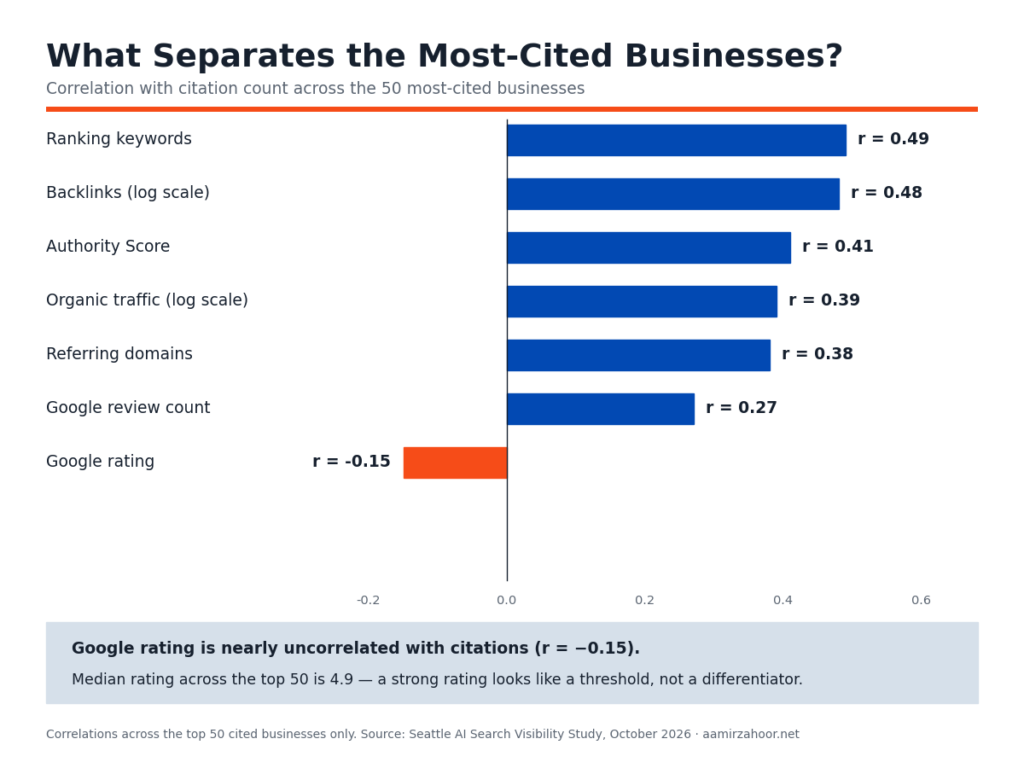
Here’s what the numbers actually say: star rating has essentially no relationship with how often a business gets cited. The correlation is −0.15, basically zero. Review count is only weakly positive.
That sounds contradictory until you think about it. Everyone in the top 50 is already rated 4.6 or higher. When everyone has great ratings, ratings can’t explain who wins.
A strong Google profile looks like a threshold you probably need to be in the game at all, but it doesn’t determine who gets cited most.
What does correlate, moderately: traditional SEO. Ranking keywords (0.49), backlinks (0.48), Authority Score (0.41), organic traffic (0.39).
Those are real signals, but the best of them explains only about a quarter of the difference in citation counts. Most of what makes a business get cited isn’t in those metrics.
The businesses that break the rules
The outliers are my favorite part, because they break every simple theory:
- Merv Bellevue has an Authority Score of 2, zero estimated organic traffic, and one ranking keyword. It was cited 6 times. (It does have a 4.9 Google rating.)
- Tempra HVAC has an Authority Score of 8 and 74 estimated monthly organic visits. Semrush’s own AI tracking gives it an AI visibility score of zero. It was cited 6 times. (5.0 Google rating.)
- True Shield Roofing has an Authority Score of 8, 25 estimated monthly visits, and no Google listing at all. It was cited 6 times.
If your theory is “AI cites the businesses with the strongest SEO,” these three falsify it. Weak traditional SEO didn’t block any of them from being cited repeatedly.
Something else: local relevance, the sources AI draws on, and directory presence are doing work that the usual metrics don’t capture. I don’t have a clean answer for what that something is. That’s the honest state of it.
What I’d tell a local business owner?
If you run a home-services business in the Seattle area, here’s what I’d take from this:
First, check each platform separately:
Being visible on ChatGPT says nothing about Perplexity, and vice versa. The platforms disagree constantly.
Second, treat your Google profile as table stakes:
Nearly every cited business had a 4.6+ rating and hundreds of reviews. That alone won’t make you the most-cited, but lacking it seems to be a real handicap. True Shield is the one exception in the top 50, not the rule.
Third, keep doing real SEO:
Keywords, links, and authority still correlate with citations. They just aren’t the whole game, so don’t let anyone sell you “AI visibility” as a replacement for them — or as a magic trick that ignores them.
Fourth, be findable where AI looks:
Directory-review sources showed up in every single answered prompt. Business-owned pages showed up in 280 of 375.
Google Maps showed up in 197. If your business has no presence in those source types, there’s little for an AI answer to cite.
Fifth, depth in your market beats breadth across markets:
The winners in Everett, Tacoma, and Bellevue were businesses rooted in those places.
What this study can’t tell you?
A few honest limits. This was one day, October 16, 2026. AI answers change constantly. I ran each prompt once, so the clarification-only and guide-only responses stayed as they were.
I enriched only the top 50 businesses with SEO and Google data, so the correlations describe the most-cited, not every business.
The Semrush numbers are estimates, and some of them swing wildly month to month. And I didn’t measure Google Business Profile ranking position; there was no clean way to do it, so I left it out.
The full report methodology, every table, the complete top-50 dataset with SEO and Google metrics, and all the limitations can be found on the Seattle SEO website in the Seattle AI Search Visibility Report 2026.
The question I started with was whether AI answers will replace Google for local businesses. After 400 observations, my answer is: not yet, and not in the way people assume. AI answers are already a real visibility channel; 770 businesses got named in a single day of testing.
But they’re fragmented, inconsistent, and they don’t follow the rules most SEOs expect. The businesses winning in them are locally rooted, well-reviewed, and present in the sources AI actually reads. That part, at least, hasn’t changed.
